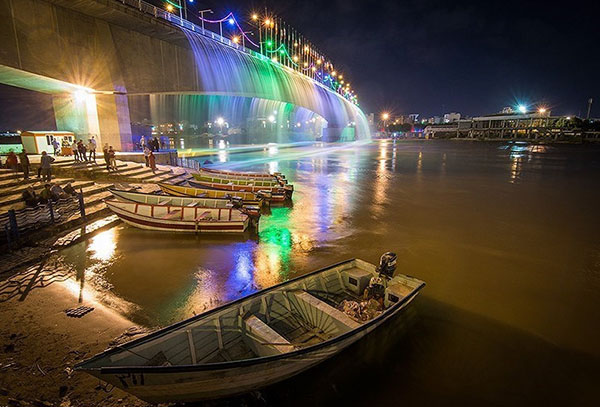
[custom_adv] Ahwaz is a city in the south of Iran. At the 2011 census, its population was 1,112,021 and its built-up (or metro) area with Sheybany was home to 1,136,989 inhabitants.Ahvaz has the world's worst air pollution according to a survey by the World Health Organization in 2011. [custom_adv] Ahwaz is built on the banks of the Karun River and is situated in the middle of Khuzestan Province, of which it is the capital and most populous city. The city has an average elevation of 20 meters above sea level. [custom_adv] The seat of the province has, for the most of its history, been in the northern reaches of the land, first at Susa (Shush) and then at Shushtar. During a short spell in the Sasanian era, the capital of the province was moved to its geographical center, where the river town of Hormuz-Ardashir (modern Ahwaz). [custom_adv] However, later in the Sasanian time and throughout the Islamic era, the provincial seat returned and stayed at Shushtar, until the late Qajar period. With the increase in the international sea commerce arriving on the shores of Khuzestan, Ahvaz became a more suitable location for the provincial capital. [custom_adv] The River Karun is navigable all the way to Ahwaz (above which, the Karun flows through rapids). The town was thus refurbished by the order of the Qajar king, Naser al-Din Shah and renamed after him, Nâseri. Shushtar quickly declined, while Ahwaz/Nâseri prospered to the present day. [custom_adv] In the 19th century, "Ahwaz was no more than a small borough inhabited mainly by Sabeans (1,500 to 2,000 inhabitants according to Ainsworth in 1835; 700 according to Curzon in 1890)." [custom_adv] In the 1880s, under Qajar rule, the Karun River was dredged and re-opened to commerce. A newly built railway crossed the Karun at Ahwaz. The city again became a commercial crossroads, linking river and rail traffic. [custom_adv] The construction of the Suez Canal further stimulated trade. A port city was built near the old village of Ahwaz, and named Bandar-e-Naseri in honor of Nassereddin Shah Qajar. [custom_adv] Oil was found near Ahvaz in the early 20th century, and the city once again grew and prospered as a result of this new found wealth. From 1897-1925, the city of Ahwaz was in the hands of heshmatoddoleh Ghajar, whom acted as governor and Sarhang Reza Gholi Khane Arghoon as commander of Ghajari's army based in Khuzestan. [custom_adv] The government of the Khūzestān Province was transferred there from Shûshtar in 1926. The trans-homeland railroad reached Ahwaz in 1929 and by the World War II, Ahvaz had become the principal built-up area of interior of Khūzestān.