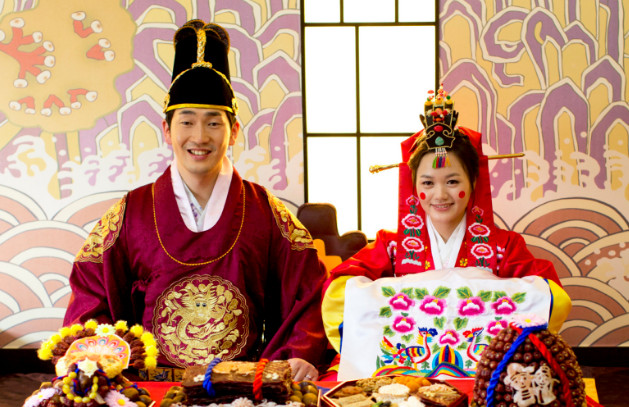
[custom_adv] Peru Although most of the families now celebrate with Catholic rituals, some cities and towns still observe the customs of their ancestors. Peru and Bolivia share very similar traditions that are spiritual, romantic, and recently sought after by engaged couples who are planning their destination weddings. [custom_adv] Indonesia An Indonesian marriage has three components: civil, religious, and a celebration which follows regional customs and traditions.The festive celebration is often separate, and may occur days or even weeks after the legal and religious ceremonies. [custom_adv] Pakistan Marriage, in Pakistan is a legal union between a man and a woman. Culturally, it is not only a link between the husband and wife, but also an alliance between their respective families. Because about 97% of Pakistan's population is Muslim the Islamic law (Sharia) is usually observed. [custom_adv] Nigeria Nigerian nuptials come with the fantastic opportunity to have up to three different wedding ceremonies, with a choice of civil, religious and traditional ceremonies. Of course a couple could choose to have just one or two, but it’s possible to have all three if you can afford it! [custom_adv] Turkey Even modern Turkish weddings have a real traditional vibe with a whole range of customs and superstitions which can vary greatly across the different regions and districts of Turkey itself. However, an issue which affects marriage in Turkey is the fact that there is still compulsory service (conscription) to the Turkish military in place for Turkish men. [custom_adv] South korea Marriage in South Korea is similar to that in the West, but has unique features of its own, especially due to the influence of Korean Confucianism. [custom_adv] Eritrea Among this ethnic group, engagement is a family’s affair. The future spouses have no say whatsoever in their future married life. If for some reason two lovers get married without prior permission from their respective parents, the boy is obliged to pay a certain sum of money plus an ox to the girl’s father. [custom_adv] Tibet Proposal is the first step of marriage. Traditionally, if a man is interested in a lady, he will seek her age, date of birth and her zodiac attribute (i.e mouse, ox, tiger, rabbit, dragon, snake, horse, sheep, monkey, chicken, dog or pig). With all the information on hand, he will consult an astrologist to check if her attributes are compatible with his. [custom_adv] Palestine Arabic Weddings have changed greatly in the past 100 years. Original traditional Arabic weddings are supposed to be very similar to modern-day Bedouin weddings and rural weddings, and they are in some cases unique from one region to another, even within the same country. [custom_adv] Jordan The culture of Jordan is based on Arabic and Islamic elements with significant Western influence. The Jordanian Kingdom had always been the intersection of the three continents of the ancient world and always seemed to have a form of diversity at any given point due to its location. [custom_adv] Sri lanka A Poruwa ceremony is a traditional Sinhalese wedding ceremony with Buddhist influences. The ceremony takes place on a "Poruwa", a beautifully decorated, traditional wooden platform. The ceremony involves a series of rituals performed by the bride and groom, and their families. [custom_adv] Bulgaria In Bulgaria, the betrothal customs have remained largely unchanged over many centuries. Unlike many other cultures, the Bulgarian marriage routines have always paid great attention to the bride’s rights to choose her partner. Her suitor would traditionally send a best friend (likely to be his best man if things all panned out well), to the bride’s house to ask for her father’s blessing. [custom_adv] India Marriages in India are filled with ritual and celebration that continue for several days. Usually around 100 to 10,000 people attend. Attendees are frequently not known directly by the bride and groom. Though most Indian marriages are arranged,some couples in urban areas consummate "love marriages", in which the partners decide to marry each other without family involvement or assistance. [custom_adv] Japan Marriage in Japan is a legal and social institution at the center of the household. Couples are legally married once they have made the change in status on their family registration sheets, without the need for a ceremony. Most weddings are held either according to Shinto traditions or as a Christian-style chapel weddings.